Europe’s data centre sector knows where it is going. More compute, more capacity, more digital infrastructure to support everything from cloud services to artificial intelligence. What is less clear is how quickly the systems that power that growth can realistically keep up.
Electricity demand from data centres is rising fast, and in many European markets it is already testing the limits of grid infrastructure built for a different era. Across Europe, data centre demand alone is projected to grow from around 10 GW today to as much as 35 GW by 2030, with electricity consumption more than doubling over the same period.1
This persistent gap between ambition and readiness is creating the conditions for battery energy storage to earn a bigger, more critical role in data centre power infrastructure.
The map is changing
For much of the past decade, Europe’s data centre growth clustered around a small number of established hubs: Frankfurt, London, Amsterdam, Paris, and Dublin. That concentration is now easing, with new capacity increasingly planned across the Nordics, Iberia, and Central, and Eastern Europe,2 where greater space availability, competitive development costs, and access to renewable energy are proving attractive.
These opportunities come with trade-offs. Grid infrastructure is often constrained not only in newer markets but also in mature ones such as Germany and the UK, where congestion and variable permitting processes make predictability harder.
The grid is the bottleneck
Across Europe, grid connection queues are lengthening. Indeed, it has been estimated that more than 1700 GW of renewable energy is stuck in connection queues.3 In several key markets, timelines for upgrades and reinforcements stretch years into the future, while data centre build schedules continue to operate on much shorter horizons. This mismatch is not the result of inaction; grid operators are investing heavily, and regulatory frameworks continue to evolve. At the same time, individual AI data centre facilities can now require 50 MW or more of power capacity, with the largest sites exceeding 100 MW in some cases.4 As a result, the misalignment between grid delivery timelines and data centre build schedules has become one of the most material constraints on new projects.
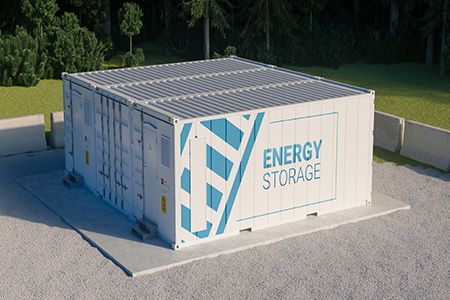
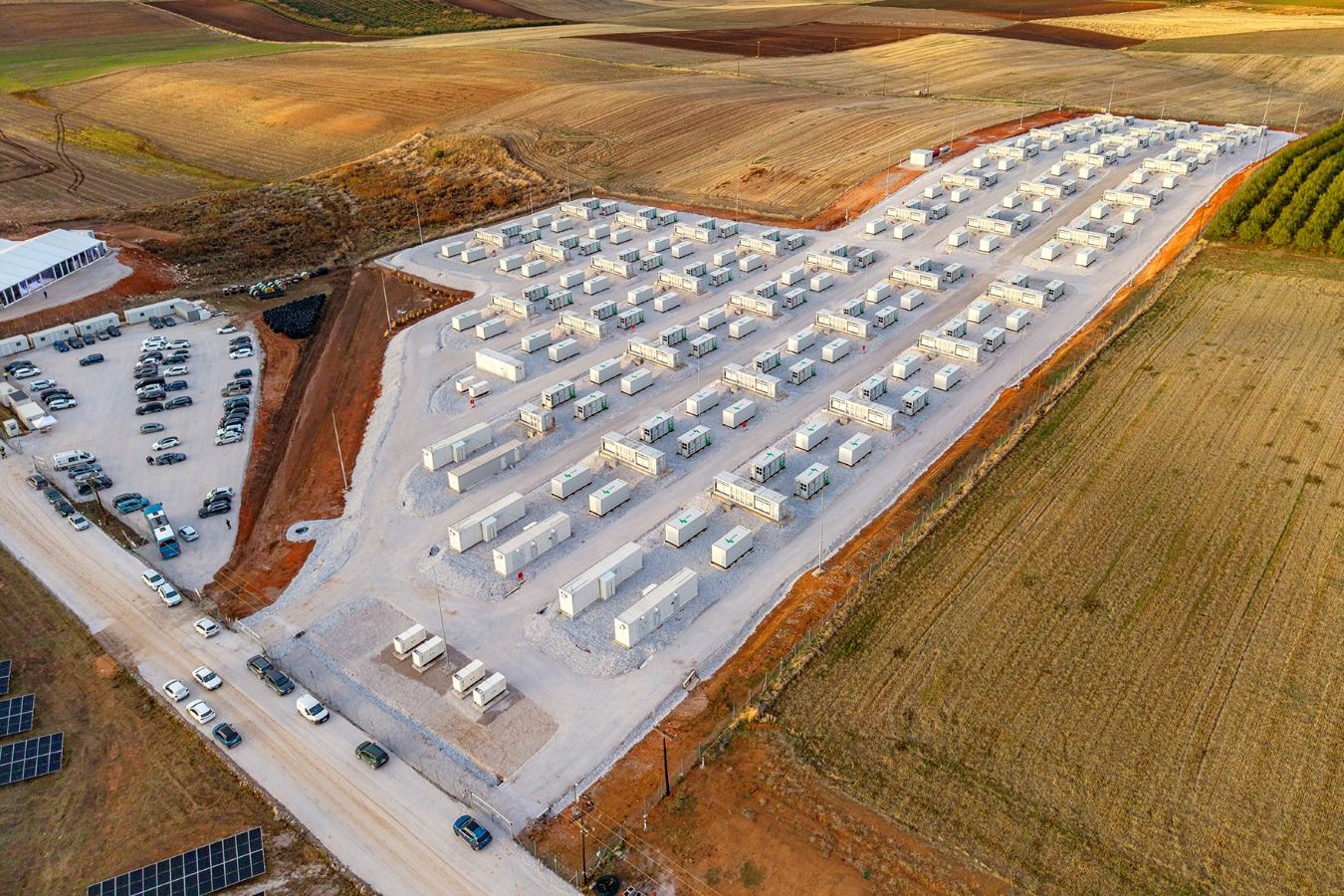
Battery energy storage systems (BESS) are increasingly being deployed at or alongside data centres to address this mismatch. Standardised, modular, factory-integrated systems compress deployment timelines and enable projects to move forward even when grid capacity lags development ambition.
This is the context in which battery storage stops being an optimisation tool and starts becoming a structural requirement for project viability.
BESS is no longer a utility asset
This shift in role reflects a broader change in how storage is perceived. Historically, BESS sat behind the meter – a supporting asset focused on cost management or backup power. That distinction is fading.
What has changed is not just where storage sits, but what it is now expected to do. Modern BESS platforms are software-defined and remotely monitored, embedded within data centre operations rather than operating in isolation. They increasingly play an active role in how sites respond to grid conditions, rather than simply absorbing or discharging power on command.
Advances in thermal management, system intelligence, and AI-enabled control now support continuous performance optimisation and predictable operation over longer lifecycles. Grid-forming capabilities add another dimension, enabling BESS to contribute to system stability by establishing voltage and frequency themselves, rather than simply following existing grid conditions – this is critical for grids increasingly dominated by renewables.5 As a result, the traditional boundaries between utility scale and commercial and industrial storage are becoming more fluid, reflecting the scale, criticality, and operational expectations of today’s data centres.
BESS has therefore moved into the core infrastructure stack. A data centre’s resilience is only as strong as the systems it depends on, and storage is now firmly among them. That promotion matters. Once storage becomes foundational rather than auxiliary, it must be judged by the same standards applied to any other mission-critical system.
Promotion brings responsibility
As storage becomes critical infrastructure, expectations around security and safety must rise accordingly, not as an optional extra, but as a baseline requirement.
In a highly connected environment, a compromised energy system can translate directly into operational disruption and end-customer impact. As storage becomes more software-driven and more tightly integrated into site operations, decisions about energy infrastructure increasingly carry direct cybersecurity implications. Put simply, storage platforms must be secured with the same rigour as the data centres they support.
Physical safety is equally critical. Thermal management, fire protection, and fault isolation are essential in dense, high-value environments where tolerance for failure is minimal. For operators, this is no longer just a technical consideration but a commercial one, shaping site approvals, partner selection, and long-term trust. Energy partners are expected to demonstrate credible compliance, transparency in system architecture, and a secure-by-design approach across hardware and software. Those that do so are better positioned to earn trust and unlock more projects.
Conclusion
Europe’s data centre energy challenge and its security challenge are converging, and storage sits at the point of intersection.
As BESS moves into core infrastructure, how it is deployed, managed, and secured will determine whether it truly earns its promotion. The next phase of data centre development will be shaped not just by how much capacity is added, but by how resilient and secure the systems behind it prove to be.
References
1 ‘The role of power in unlocking the European AI revolution’, McKinsey & Company’, (24 October 2024), https://www.mckinsey.com/industries/electric-power-and-natural-gas/our-insights/the-role-of-power-in-unlocking-the-european-ai-revolution
2 JACAMON, V., DALLARD, J., and SPENCER, T., ‘Overcoming energy contraints is key to delivering on Europe’s data centre goals’, International Energy Agency, (16 November 2025), https://www.iea.org/commentaries/overcoming-energy-constraints-is-key-to-delivering-on-europe-s-data-centre-goals
3 LEUNG, K. and BRUEGEL, J., ‘How Europe’s grid operators are preparing for the energy transition’, Institute for Energy Economics and Financial Analysis, (13 May 2025), https://ieefa.org/resources/how-europes-grid-operators-are-preparing-energy-transition
4 MASANET, E., and LEI, N., ‘How Much Energy Do Data Centers Really Use?’, Energy Innovation, (20 March 2020), https://energyinnovation.org/expert-voice/how-much-energy-do-data-centers-really-use/
5 ‘Grid-forming technology is no longer experimental – it’s here and working’, Sungrow, (7 July 2025), https://www.sungrowpower.com/eu/en/newsdetail/6608